Jump to a section
Count the cars in your school's pickup line tomorrow. Then count the empty seats.
Plenty of those cars carry one child. Some of them live a few streets apart, and the parents have never met.
PTAs fund field trips, staff the book fair and run the fall festival. The daily drive, the one thing every family deals with twice a day, rarely makes the agenda. It should. But there's a catch in how a PTA can help, and it's worth getting right.
The Drive Is the Biggest Shared Chore at School
The numbers on how kids get to school are old, but the direction is clear.
In 1969, 12 percent of children aged 5 to 14 got to school by private car. By 2009, it was 44 percent (Safe Routes to School National Partnership, 2010). That same 2009 data found that cars taking students to school made up 10 to 14 percent of all personal vehicle trips in the morning rush, and that about 40 percent of parents who drove went straight back home afterward (National Center for Safe Routes to School, 2011). That's a lot of trips with an empty car on the way home.
Newer surveys say it hasn't eased. In a 2025 survey AP-NORC ran for HopSkipDrive, a company that sells student rides to districts, 89 percent of school administrators said their students are typically driven to school. Among parents, 11 percent said they had lost a job because they needed to get their kids to and from school or activities (K-12 Dive, September 2025).
That last number is the one a PTA should sit with. For some families the school run isn't an annoyance. It's the thing that decides whether a parent can keep working.
Why It Belongs on the PTA's Agenda
A carpool needs one thing families can't easily get on their own: knowing who else lives nearby. That's exactly what a PTA is good at.
- New families know nobody. They're the ones driving alone every day, because they haven't met anyone to ask.
- Bus routes are shrinking in some districts, and the families who lose a stop need each other fast. Our School Bus Cuts guides track several districts.
- It's an easy win. A lot of PTA projects take money or a weekend. Helping families find a carpool takes a sign-up form and a little care.
The Catch: A PTA Shouldn't Endorse a Product
PTA bylaws generally bar the organization from backing a company. California State PTA's bylaws, for example, say the organization and its members, in their official roles, "shall not endorse a commercial entity" (California State PTA bylaws, Article III). Your state's wording may differ. Check it.
So a PTA shouldn't put its name behind any one carpool app, including ours. What it can do is make carpooling easier to start, and let families choose their own tool.
Five Things a PTA Can Do This Year
1. Run an opt-in carpool list
A simple form: grade, nearest cross streets (not a home address), mornings or afternoons, and a contact. Share it only with the families who signed up, and only with their permission. That list is the hardest part of starting a carpool, and the PTA can build it in a week.
2. Put it on the back-to-school table
A sign-up sheet at meet-the-teacher night, sorted by neighborhood. If school has already started, the first fall meeting or the next newsletter works.
3. Share the options, not a pick
A short "ways to share the drive" note can cover a printable schedule, a shared spreadsheet, and the carpool apps families already use. Our free carpool schedule template is one option on that list. Before naming any company in a PTA message, run it past your board, and your state PTA if you're unsure.
4. Talk to the principal about the drop-off line
Ask where carpools should load, and whether the school wants to encourage them. A line with fewer cars helps everyone in it.
5. Be the hub when routes change
When a district cuts or moves a bus stop, the PTA can be the first place families look. Post the change, link the district's transportation page, and open the carpool list to the families affected.
What It Costs
For the PTA: a volunteer's time and a free form.
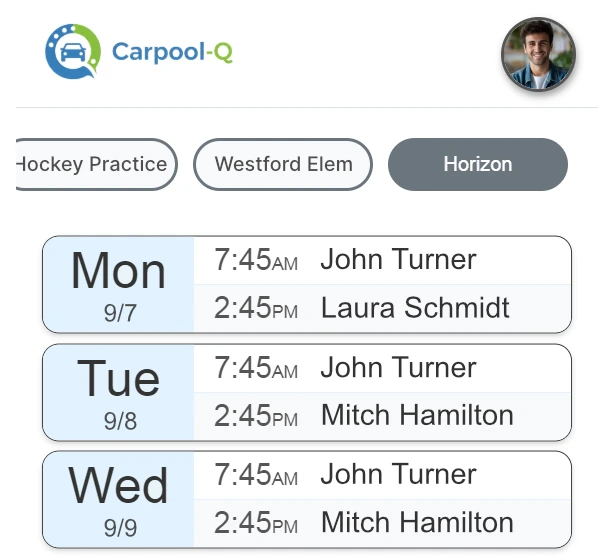
For families, it depends on the tool. Paper and spreadsheets are free. Apps vary. Carpool-Q, which we make, is $1.99 a month per family after a 14-day free trial. It keeps one shared week for the carpool: who drives, which kids aren't riding and why, different times on early release days, and a reminder to the driver before each trip. We'd rather families use any shared schedule than none.
Start With the List
If your PTA does one thing this year, make it the opt-in carpool list. It costs nothing, it respects the no-endorsement rule, and it gives the parent who's driving alone every day a name to call.