Jump to a section
This fall, Columbus City Schools in Ohio stopped busing K-8 students to most of its lottery schools, unless it's the child's assigned school. The district planned 419 bus routes, down from 494 the year before, to save about $7.8 million (WSYX, August 2026).
Columbus isn't the only one. The yellow bus still runs in most places. It's carrying fewer kids to fewer places, and families are covering the difference in their own cars.
Here's what's behind that, what the next few years are likely to bring, and where carpooling fits.
What Changed This School Year
A few examples from districts we track:
- Louisville, Kentucky. The Jefferson County board voted in April 2024 to end busing to most magnet and traditional schools (Spectrum News, July 2026). Some service has returned. Then the city's new transit network, launched in August, stopped serving five high schools (TARC).
- Chicago. Chicago Public Schools says that because of the bus driver shortage, it may not be able to transport every general education student in a magnet or selective program. Eligible students may get a hub stop or a transit card instead (CPS Transportation Services).
- Lincoln, Nebraska. Lincoln Public Schools planned 128 routes and wants 150 once it has the drivers. Earlier consolidations meant some students could ride as long as 90 minutes (KLIN, July 2026).
The Two Reasons: Drivers and Money
In a 2025 survey of 510 school administrators, run by AP-NORC for HopSkipDrive, 81 percent said bus driver shortages are a problem in their district, and 46 percent called it a major one. Twenty-six percent said they had cut or shortened routes because of it, and 73 percent said transportation budget shortages had affected their operations (K-12 Dive, September 2025). The administrators weren't randomly sampled, so read those numbers as direction, not precision. HopSkipDrive also sells rides to districts, so it has a stake in the answer.
A separate February 2026 survey of 118 transportation professionals, by Zonar and School Transportation News, found 75 percent naming driver shortages as their top challenge (Zonar, 2026).
HopSkipDrive's 2026 report, released in August, leads with a warning worth repeating: a drop in districts feeling constrained by driver shortages "doesn't mean the problem is improving" (HopSkipDrive, 2026).
Kids Were Moving Into Cars Long Before This
The shortage is recent. The shift to the family car isn't.
In 1969, 12 percent of children got to school by private car. By 2009, it was 44 percent. Over the same forty years, bus ridership barely moved, from 38 to 40 percent (Safe Routes to School National Partnership, 2010). The car didn't replace the bus. It replaced walking: 48 percent of K-8 students usually walked or biked to school in 1969, and 13 percent did in 2009 (National Center for Safe Routes to School, 2011).
So the families losing a bus stop this year are joining a group that was already the largest.
What the Next Few Years Probably Look Like
Nobody can tell you what school transportation looks like in 2031, and we won't pretend to. But four trends are already underway.
1. Narrower eligibility. Longer walk distances, no busing to schools families chose, and hub stops in place of corner stops. A district that can't hire drivers fast enough shrinks the routes to fit the drivers it has. 2. Districts paying for alternatives. Transit passes, contracted ride services, and in some places payments to families. Chicago's financial incentive program pays some families to drive a student whose IEP or 504 plan lists transportation, when the district can't route them (CPS). 3. Public transit as a partial answer. Where city buses reach schools, older students can ride them. But transit agencies redraw their own routes, as Louisville's did in August. It's a fallback, not a guarantee. 4. Families filling the rest. This is the biggest one, and the least organized. Neighbors split mornings. A parent who starts work early takes three kids. It mostly runs on group texts and goodwill.Where Carpool Tech Fits, and Where It Doesn't
The fourth trend is where an app like ours comes in, so here's what it does and doesn't do.
A carpool app doesn't replace a bus. It doesn't put a new driver on the road or a new seat in a car. And Carpool-Q doesn't match strangers; it's for families who already know each other and already share the drive.
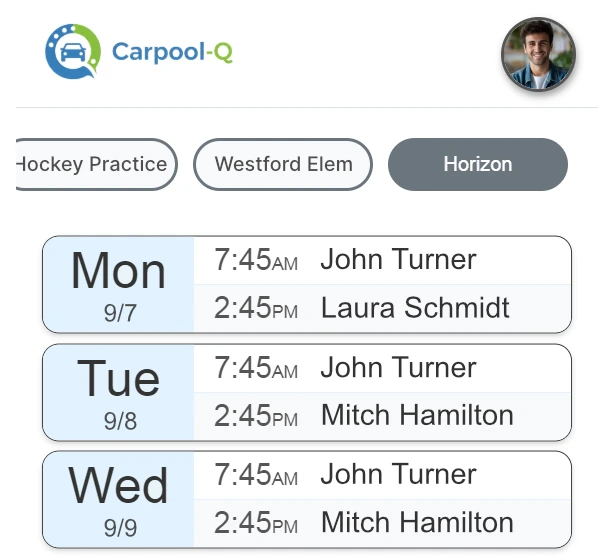
What it does is make that arrangement less fragile. One shared week shows every driver, every time and every child who isn't riding. Drivers get a reminder before each trip, and everyone hears when tomorrow has no driver. Holidays and field trips go on and off the schedule with the +/- button, and early release days keep their own times. It's $1.99 a month per family after a 14-day free trial. A free printable schedule does the basics if that's all you need.
Families have always shared the drive. What's new is how many now depend on it every day, and how little room that leaves for a missed text.
If Your Route Is Next
- Read your district's current policy, not last year's. Distance rules and exceptions change.
- Ask about the nearest existing stop, even if your address doesn't qualify.
- Find your families early. Our back-to-school planning guide walks through it step by step.
- Ask your PTA to help. An opt-in carpool list is the fastest way to find the family down the street. Here's how a PTA can run one.